
How to Measure for a Chimney Cap
Key Takeaways
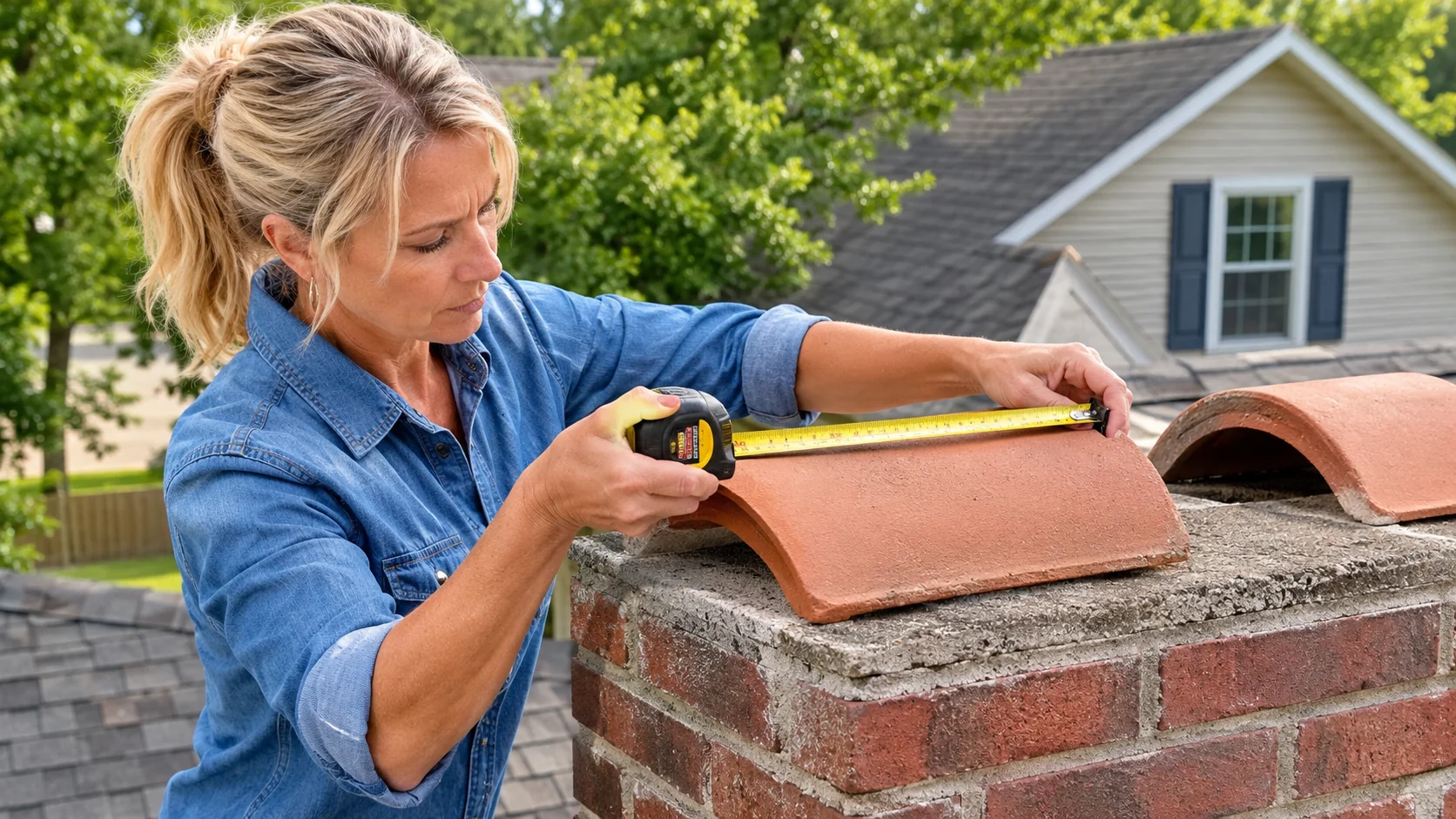
- For a clay tile flue, measure the outside length and width of the tile at the top and how far it sticks up above the crown.
- For a round liner or metal pipe, measure the inside diameter. Caps for round pipe are sold by inside diameter.
- For a multi flue cap, measure the crown, the area covering all flues, and the height of the tallest flue.
- Chimney caps are not universal. Each size fits a narrow range of flues, so measure the flue you have.
- Too big leaves gaps for animals and lets the cap rattle. Too small will not fit or restricts draft.
Most chimney cap problems start with the wrong size. A cap that is too big rattles, lets animals squeeze in and can blow off. A cap that is too small will not fit or chokes the draft. The fix is simple: measure for a chimney cap before you buy, and match your measurements to the maker’s fit range. With your numbers in hand, the best chimney cap for your flue is much easier to pick.
This guide shows how to measure every common chimney: square and rectangular clay tiles, round liners and pipe, oval flues and multi flue crowns. It also covers common sizes and the clearance a cap needs above the flue.
Before You Measure: Safety First
Measuring means getting onto the roof. Chimney tops are high, exposed and often slippery.
- Work only in dry, calm weather.
- Use a sturdy ladder that extends at least 3 feet above the roof edge.
- Use a roof harness and anchor on steep or high roofs.
- Have someone on the ground.
- Let any fire go out and the chimney cool fully.
If you are not comfortable on the roof, a chimney sweep can measure during an inspection. Some sweeps will also take photos with a tape in frame for you.
What You Need
- A metal tape measure.
- A notepad or phone for numbers and photos.
- A flashlight to look into the flue.
- A straight edge or level for crowns.
Step 1: Identify Your Flue Type
Look at the top of the chimney. You will see one of these:
- Square or rectangular clay tile sticking up from the crown.
- Round stainless liner ending at a top plate or sticking up from the crown.
- Round metal pipe from a prefab or Class A chimney.
- Oval liner, less common, in relined fireplaces.
- Several flues close together on one crown.
Each type is measured differently.
How to Measure a Square or Rectangular Clay Flue Tile
Step 1: Measure the Outside Length
Measure across the outside of the tile at the top, on the longer side. Measure to the outer edges, not the inner opening. Write it down to the nearest 1/8 inch.
Step 2: Measure the Outside Width
Measure across the shorter side the same way.
Step 3: Measure the Height Above the Crown
Measure from the crown surface to the top of the tile on the lowest side. Bolt-on caps need enough tile to grip, typically at least 3 to 4 inches. If the tile is too short, you may need a different mounting style or a multi flue cap.
Step 4: Check the Tile Is Square and Sound
Look for cracks, chips or a tile that leans. A broken tile will not hold a bolt-on cap.
Step 5: Match to the Fit Range
Caps are sold by nominal flue size, such as 9 x 9, 9 x 13, 13 x 13 or 13 x 18 inches. Each nominal size fits a range of real tile sizes. HY-C, for example, lists its 18 x 18 inch copper cap as fitting tiles from 16 1/2 x 16 1/2 inches up to 18 x 18 inches. Choose the size whose range includes your measurements.
Common Clay Flue Tile and Cap Sizes
| Nominal tile size | Typical use | Example caps |
|---|---|---|
| 8 x 8 or 9 x 9 in | Furnace, water heater, small stove | HY-C SC99 (9 x 9), Draft King CP99 |
| 8 x 13 or 9 x 13 in | Small fireplaces | HY-C stainless 9 x 13, Draft King CP913 |
| 13 x 13 in | Medium fireplaces | HY-C SS1313U stainless |
| 12 x 16 in | Medium fireplaces | Draft King CP1216 |
| 13 x 18 in | Large fireplaces | HY-C stainless 13 x 18 |
| 18 x 18 in | Large fireplaces | Draft King CP1818 |
| 18 x 9 in | Long rectangular tiles | HY-C CBO918 |
Real tiles vary from nominal size, so always measure.
How to Measure a Round Liner or Metal Pipe
Step 1: Measure the Inside Diameter
Measure across the inside of the pipe or liner opening through the center. Round caps for liners and Class A pipe are sold by inside diameter: 6, 7, 8, 10 inches and so on.
Step 2: Measure the Outside Diameter
Measure the outside too. Some clamp style caps size by outside diameter, and storm collars always do.
Step 3: Note the Pipe Type and Brand
For prefab chimney caps on Class A pipe, find the label on the pipe or in the fireplace. The cap must match the brand and series. A 6 inch DuraTech pipe takes a 6 inch DuraTech cap, not a generic 6 inch cap.
Step 4: Check How Far the Liner Sticks Up
Liner caps clamp to the top of the liner or to a top plate. Note whether there is a top plate and how much liner is exposed.
What Size Chimney Cap for an 8 Inch Flue?
“8 inch” can mean two different things:
- An 8 inch round liner or pipe. Buy an 8 inch round cap made for that liner or pipe. For a DuraPlus triple wall chimney that might be the 8DP-VC. For a round stainless liner, an 8 inch liner cap. For a draft inducer, the 8 inch Vacu-Stack VSS-08.
- An 8 x 8 or 8 x 13 inch clay tile. Measure the tile’s actual outside dimensions and choose a square or rectangular cap whose range includes them.
Never buy an 8 inch round cap for a square tile or the other way around.
How to Measure an Oval Flue
Oval liners are measured by their inside long and short dimensions, such as 6 x 10 or 10 x 14 inches. Vacu-Stack, for example, lists oval caps in 6 x 10 inches and a 10 x 14 inch model for masonry chimneys. Measure both inside dimensions at the top and match them to the cap maker’s chart.
How to Measure for a Multi Flue Chimney Cap
Multi flue caps cover several flues and sit on the crown. Most are made to order, so measurements must be exact.
Step 1: Measure the Crown
Measure the length and width of the crown top. For an outside mount cap, measure to the outer edge. For a top mount cap, measure the flat area where the cap will sit.
Step 2: Measure the Area Covering All Flues
Measure from the outside edge of the first flue to the outside edge of the last, in both directions. The cap’s base must cover this rectangle with a margin.
Step 3: Measure the Tallest Flue
Measure the height of the tallest flue above the crown. This sets the mesh height.
Step 4: Add Clearance
The lid must sit above the tallest flue with the gap the maker requires. Multi flue caps come in set mesh heights, such as 8, 10 or 14 inches on the Draft King BigTop. Choose the height that clears the tallest flue with that gap.
Step 5: Photograph Everything
Take photos from above and from each side with the tape in frame. Note antenna mounts, flashing, steps in the crown and the roof pitch.
How Tall Should a Chimney Cap Be?
A chimney cap must be tall enough that the open area through its sides is at least four times the area of the flue. Model codes based on the IRC set that rule for rain caps and spark arrestors. Cap makers design their products to meet it for the flues they fit.
In practice:
- Single flue caps usually leave several inches between the top of the tile and the lid.
- Multi flue caps are sold in mesh heights such as 8, 10 or 14 inches.
- Taller is not always better. A very tall cap lets more wind driven rain under the lid.
How High Should a Chimney Cap Sit Above the Flue?
Follow the maker’s design. Do not raise a cap with spacers to gain height, and do not push it lower than designed. If your flue tile is unusually tall or short, choose a cap made for that, such as a multi flue cap with the right mesh height.
How Much Clearance Does a Chimney Cap Need?
There are two kinds of clearance:
- Above the flue: the gap between the top of the flue and the lid, set by the cap’s design to give enough open area.
- Around the flue: the gap between the cap’s skirt and the tile. This should be small, just enough for the cap to slide on, so animals cannot squeeze in.
On prefab chimneys, also check the clearances the chimney maker lists from the cap to nearby walls and roof surfaces.
Are Chimney Caps Universal?
No. Chimney caps are made for specific flue types and size ranges. Some caps are adjustable, with sliding sides or clamps that cover a wider range of tile sizes, which helps if your tile is an odd size. They still have limits. There is no single cap that fits every chimney.
Can a Chimney Cap Be Too Big?
Yes. A cap that is too big:
- Leaves gaps around the tile where animals get in.
- Sits crooked and rattles in the wind.
- Puts strain on the bolts, which can work loose.
- Can blow off in a storm.
Do not buy a bigger cap and pack the gap with mortar or foam.
Can a Chimney Cap Be Too Small?
Yes. A cap that is too small:
- Will not slide over a clay tile at all.
- On round pipe, may slip inside and restrict the flue.
- May not provide enough open area, reducing draft and pushing smoke back into the house.
How to Measure When the Flue Tile Is Damaged
If the top of the tile is cracked or chipped, measure where it is intact and note the damage. A damaged tile may not hold a bolt-on cap. Options include:
- Repairing or replacing the top tile section.
- Using a multi flue style cap that anchors to the crown.
- Having a sweep reline the flue, which comes with its own cap.
Common Measuring Mistakes
- Measuring the inside of a clay tile. Bolt-on caps fit the outside.
- Measuring the outside of a round liner when the cap is sold by inside diameter.
- Using the nominal size from memory instead of measuring.
- Forgetting tile height. Too little tile and the cap cannot grip.
- Measuring the crown instead of the flue for a single flue cap.
- Forgetting the tallest flue on a multi flue chimney.
- Mixing up round and square.
What to Do with Your Measurements
- Compare them with the cap maker’s fit chart.
- Choose the cap whose range includes your size, not the nearest nominal size.
- For prefab chimneys, confirm the brand and series.
- For multi flue caps, send measurements and photos to the maker.
- If you fall between sizes, ask the maker or a sweep before ordering.
With the right size ordered, the next job is learning how to install a chimney cap safely.
Measuring for a Chase Cover
If you have a prefab chimney in a chase, the chase cover needs its own measurements: chase length and width, skirt length, pipe outside diameter and hole position.
Measuring Tips from the Roof
- Measure twice, once in each direction, and on two sides of the tile.
- Photograph the tape against the tile so you can check later.
- Note the flue’s use: fireplace, furnace, stove or unused.
- Check the old cap’s label if one is there. It may list the size.
Measurement Worksheet
Copy this table and fill it in on the roof. It gives a retailer or sweep everything needed to recommend a cap.
| Measurement | Flue 1 | Flue 2 | Flue 3 |
|---|---|---|---|
| Flue type (clay tile, round liner, metal pipe, oval) | |||
| Outside length (inches) | |||
| Outside width (inches) | |||
| Outside diameter (round) | |||
| Inside diameter (round) | |||
| Height above crown | |||
| Tile condition (sound, cracked, chipped) | |||
| Crown length (multi flue) | |||
| Crown width (multi flue) | |||
| Fuel and appliance |
Add photos of each flue with the tape measure visible.
Worked Examples
These examples show how measurements become a cap choice. Sizes are illustrations.
Example 1: Single Clay Tile
- Outside measurements: 13 x 13 inches.
- Height above crown: 5 inches.
- Tile is sound.
- Choice: a single flue cap made for 13 x 13 inch tiles, with enough leg or skirt depth for the tile height.
Example 2: Round Stainless Liner
- Inside diameter: 6 inches.
- Liner extends above a top plate.
- Choice: a 6 inch liner cap made for that liner brand, or a universal liner cap that lists 6 inch fit.
Example 3: Two Flues on One Crown
- Flue 1: 9 x 13 inches, 4 inches above crown.
- Flue 2: 13 x 13 inches, 6 inches above crown.
- Crown: 30 x 22 inches.
- Choice: two single flue caps of the right sizes, or one multi flue cap sized to cover both flues with the clearance the maker requires above the taller flue.
Measuring for a Top Mount Damper Cap
Damper caps seal on the top of the flue tile, so measure:
- Inside dimensions of the flue tile, as well as the outside.
- The thickness and condition of the tile rim, which must be flat enough to seal.
Check the maker’s fit chart carefully, because damper frames have a narrower fit range than ordinary caps.
Measuring for a Wind Directional Cap
Most wind caps fit round liners or adapt to a clay tile. Measure as for a standard cap and note:
- The tile or liner type.
- Any nearby obstructions within a few feet of the top, which might interfere with a rotating head.
Measuring for a Decorative Shroud
Shrouds sit on the crown and cover the flues. Measure:
- Crown length and width.
- Outside length and width of the area containing all flues.
- Height of the tallest flue above the crown.
- Shape of the crown edge and any decorative brickwork.
Prefab chimney shrouds must be the ones listed for that chimney system.
Can You Measure from the Ground?
You can estimate from the ground with photos, but a guess is not good enough to order a cap. Clay tiles come in many sizes, and a cap that is even slightly too small will not fit. If you cannot safely reach the top, ask a sweep to measure during an inspection.
Metric Measurements
Some liners and imported products are sold in millimeters. One inch equals 25.4 millimeters. Round to the nearest standard size only when the maker’s fit range allows it.
Common Size Confusion
- Nominal vs actual: clay tiles are often called by a nominal size that does not exactly match the measured size. Always measure.
- Inside vs outside: single flue caps for clay tiles use the outside size; liner caps usually use the inside diameter.
- Crown vs flue: single flue caps fit the flue, not the crown.
When to Call a Professional to Measure
Call a sweep if:
- The roof is steep, high or slippery.
- The flue tile is damaged or missing.
- The chimney has an unusual shape or many flues.
- You need a custom or multi flue cap.
- You are not sure what type of chimney you have.
A sweep can also check that the chimney is safe to cap.
Measuring Questions
Should I Round Up or Down?
Neither. Write down the exact measurement and compare it with the fit range on the product listing. Most single flue caps fit a range of tile sizes, so the exact number tells you which model to buy.
What If My Measurement Falls Between Two Sizes?
Check the fit range on each model. If neither covers your measurement, look for an adjustable cap or ask about a custom size. Never force a cap that is too small or rely on bolts to hold a cap that is too big.
Do I Measure the Tile or the Crown for a Single Flue Cap?
The tile. The crown only matters for multi flue caps, shrouds and crown mounted designs.
The Bottom Line
To measure for a chimney cap, measure the outside of a clay tile, the inside diameter of a round liner or pipe, or the crown and tallest flue for a multi flue cap. Note how far the flue sticks up. Then match your numbers to the maker’s fit range. Chimney caps are not universal, and the right size is what makes a cap keep out water and animals for years.
Frequently asked questions
What size chimney cap do I need?
Measure the outside of the flue tile, or the inside diameter of a round liner or pipe, then pick the cap whose listed fit range includes your measurements.
Are chimney caps universal?
No. Each cap fits a specific range of flue sizes and types. Some adjustable caps cover wider ranges, but you still need to measure.
Can a chimney cap be too big?
Yes. An oversized cap leaves gaps animals can use, sits crooked, rattles in wind and can blow off.
Can a chimney cap be too small?
Yes. A cap that is too small will not fit over the tile, or for round pipe will restrict the flue and reduce draft.
How tall should a chimney cap be?
Tall enough that its open area is at least four times the flue area, as model codes require. Makers design their caps for this, so follow their fit chart.
What size chimney cap for an 8 inch flue?
For an 8 inch round liner or pipe, an 8 inch round cap from the right maker. For an 8 x 8 or 8 x 13 inch clay tile, measure the tile's outside dimensions and choose the cap that fits them.